The Story Behind the Photograph
The trip that finally took me to the Great Wall kept going west, up onto the plateau, into thin air and enormous light. Wildlife was the excuse, as always, but the photographs that came home from Tibet were mostly of people — pilgrims, herders, grandmothers spinning prayer wheels — because at fifteen thousand feet the human faces are as weathered and magnificent as the landscape that made them.
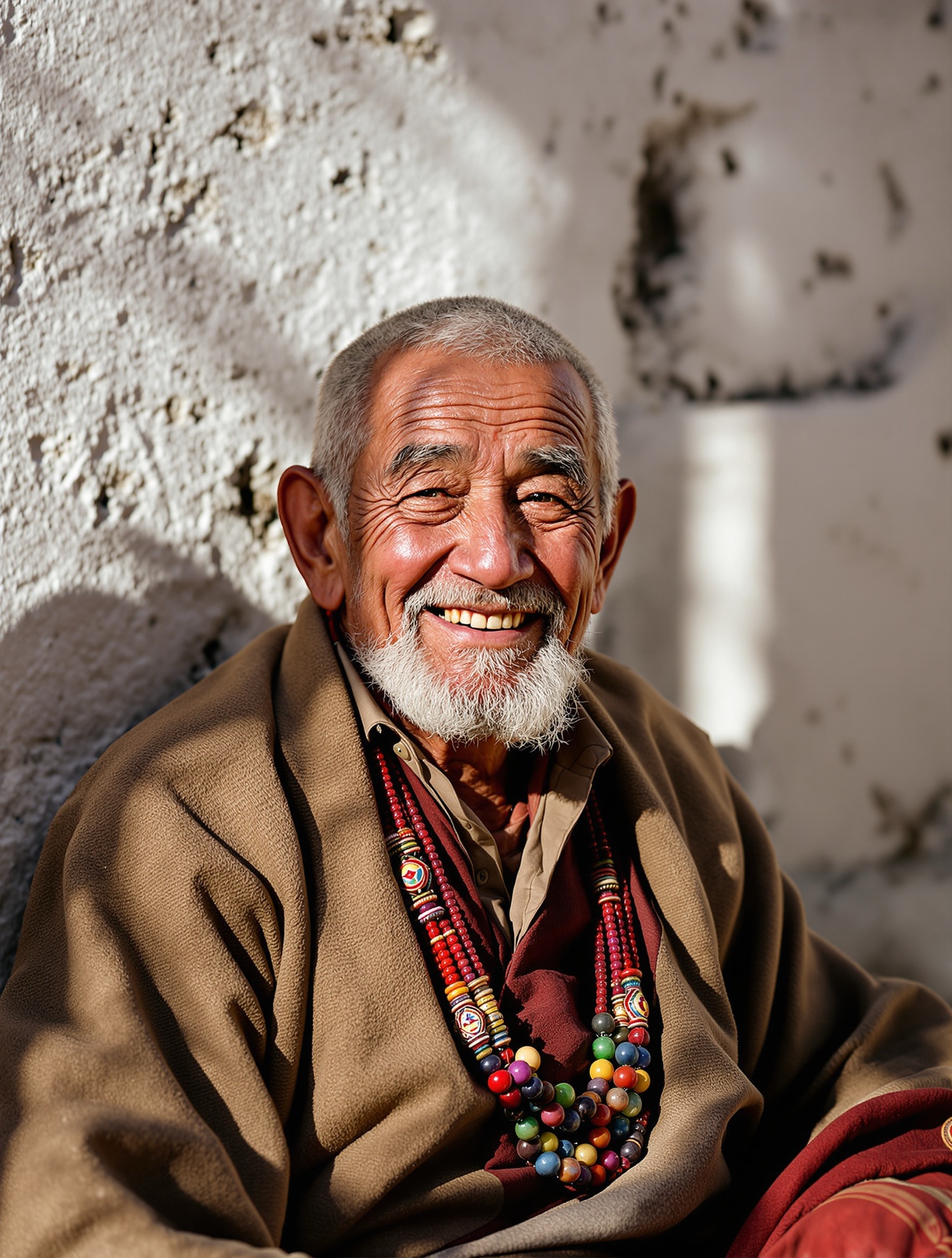
This portrait came from a market morning. An elder sat in the sun against a whitewashed wall, turning prayer beads, watching the commerce with fifty years of amusement in the creases around his eyes. Through our guide, I asked permission to photograph him. He considered the request as seriously as a loan application, agreed, and then — this is the part the photograph caught — decided to enjoy it.
About the High Plateau
The Tibetan Plateau is the highest and largest plateau on Earth, an expanse of grassland, glacier and sky averaging higher than most mountains' summits. Life there — human and wild — is a study in adaptation: yak herding economies, barley agriculture in the valleys, and wildlife like the kiang and black-necked crane found nowhere else. The plateau's cultures and ecosystems are documented in depth by institutions such as the Smithsonian Institution, whose folklife archives include extensive work on Tibetan traditions.
For a portrait photographer, the plateau offers the world's best natural studio: dry air, high thin cloud, and light that wraps a face instead of carving it.
Photographer's Notes
Made with a short telephoto at a respectful distance after asking permission — always, everywhere, but doubly so far from home. The whitewashed wall served as a natural reflector, and the portrait needed no more arranging than the man had already done with his own life. At the shows, this print made people stand still longer than any wildlife image except the wolves. It hangs in the collection beside the Antarctic Picture Frame — the two ends of the Earth, looking back at the camera.