The Story Behind the Photograph
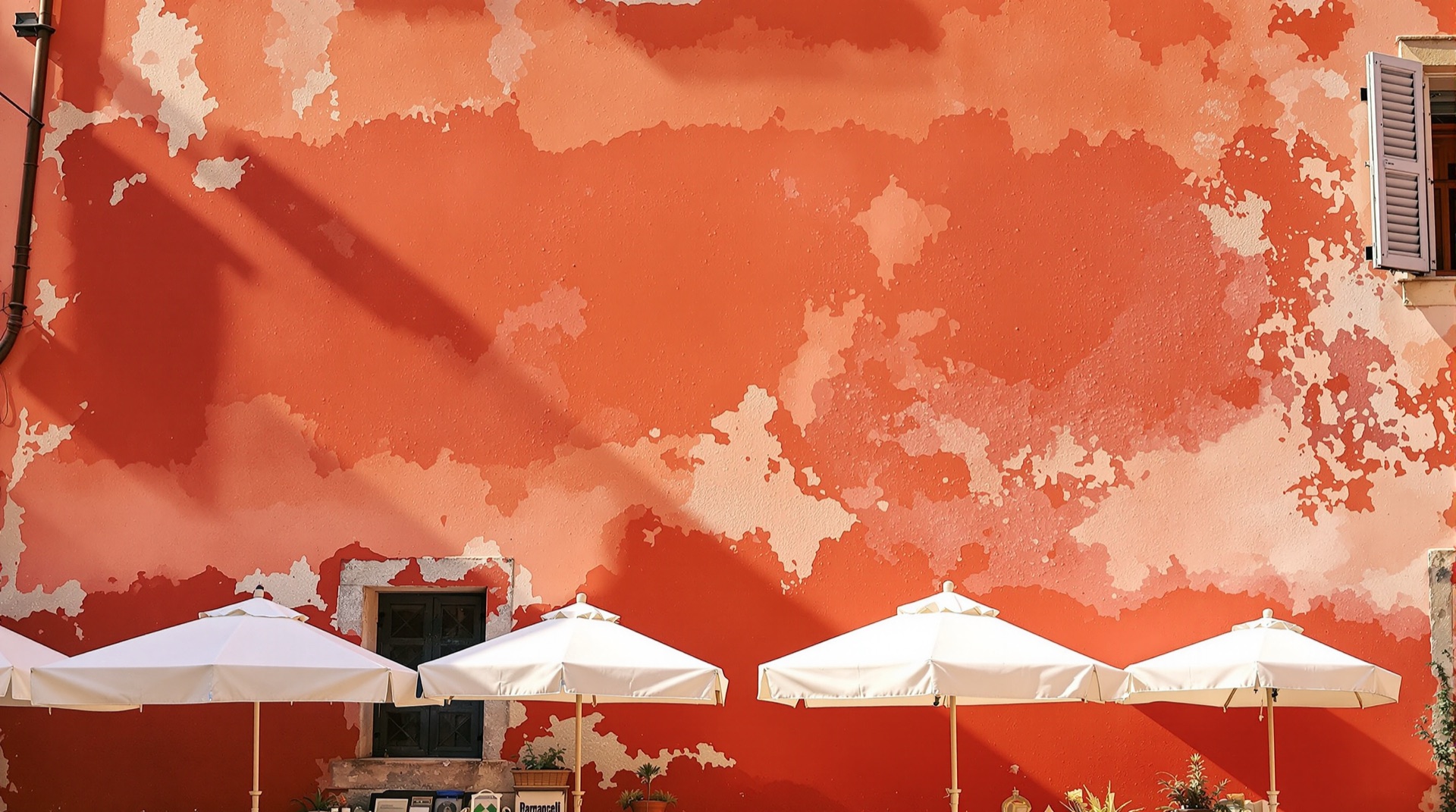
Market morning in a Tuscan hill town runs on a schedule older than clocks: vans at dawn, stalls by seven, espresso at eight. I was there for the espresso. While I waited at the bar, the stall keepers across the piazza cranked open their umbrellas one by one against a wall that had been red ochre sometime around Garibaldi and had been fading gloriously ever since.
By the third umbrella I had abandoned the espresso. The wall gave me a backdrop the size of a cinema screen — peeling, patched, six shades of red and rust — and the umbrellas opened against it like enormous flowers. I framed tight to keep out the vans and waited for the moment between customers when the geometry stood clean. One frame later the piazza filled, and the photograph was already done.
About Italy's Painted Walls
The reds and ochres of Italian towns are not decoration so much as geology: the traditional limewash pigments came out of the local earth, which is why Tuscan red, Roman ochre and Venetian rose are all subtly different colors. Old walls fade in layers as decades of limewash wear through each other — a surface conservators call patina and photographers call free art direction. Italy's heritage authorities now actively protect historic town centers and their original color schemes, part of why the country holds more UNESCO World Heritage sites than any other nation.
The lesson this image taught me: in the great photographic towns of Europe, the famous views are usually the third-best pictures. The first-best are forty feet to the left, where nobody is standing.
Photographer's Notes
Short telephoto, straight-on perspective to flatten the wall into pure color field, exposure biased dark to saturate the reds. No people in frame by choice — the umbrellas carry all the life the picture needs. At the art shows this hung with the Burano Canal and the Mexican Blue Door in what visitors called the wall-and-color row, three countries arguing about which one owns the color red.